
Wire EDM Machining
Wire Electrical Discharge Machining (Wire EDM), also known as wire cutting,
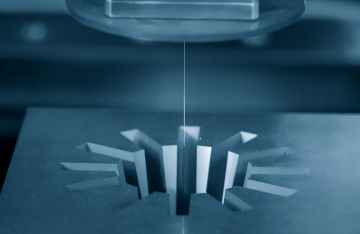 is a precision non-traditional machining process that uses a thin metal wire (typically brass or copper) as the electrode to remove material from the workpiece through successive electrical discharges.
The process occurs in a dielectric fluid environment, which cools the workpiece, flushes away debris, and maintains the stability of the electrical discharge. Unlike conventional machining, Wire EDM does not require direct contact between the tool and the workpiece, enabling high-precision processing of complex shapes without causing mechanical stress or deformation to the material.
Our EDM Processes
-
Wire cut EDM
Our Wire EDM service is adept at cutting through hardened materials and exotic alloys with exceptional accuracy.

Utilizing wires as thin as .0012 inches, it performs complex cuts in any X-Y pattern, such as small radii and tight slots, without contact, delivering burr-free finishes essential for high-precision parts. In many cases wire EDM is faster and more accurate than traditional machining methods, making it cost-effective for certain shapes. When two axis of motion are involved it results in parts with vertical edges and two-dimensional shapes. EDM wire cutting machines are capable of creating complex shapes with incredibly tight tolerances. Materials that can be cut by wire EDM include all conductive metals such as titanium, steel, aluminum, and brass.
Our Wire EDM service is adept at cutting through hardened materials and exotic alloys with exceptional accuracy.
Utilizing wires as thin as .0012 inches, it performs complex cuts in any X-Y pattern, such as small radii and tight slots, without contact, delivering burr-free finishes essential for high-precision parts. In many cases wire EDM is faster and more accurate than traditional machining methods, making it cost-effective for certain shapes. When two axis of motion are involved it results in parts with vertical edges and two-dimensional shapes. EDM wire cutting machines are capable of creating complex shapes with incredibly tight tolerances. Materials that can be cut by wire EDM include all conductive metals such as titanium, steel, aluminum, and brass.
-
Hole drilling EDM
Hole drilling EDM is a machining process that uses electrical discharges to create holes in metals, an extremely accurate and precise method of machining and can be used to create small and deep holes in very hard materials, especially used in aerospace and medical devices. This method ensures that each component meets the exacting standards of high-tech sectors.
Hole drilling EDM is a machining process that uses electrical discharges to create holes in metals, an extremely accurate and precise method of machining and can be used to create small and deep holes in very hard materials, especially used in aerospace and medical devices. This method ensures that each component meets the exacting standards of high-tech sectors.
Core Advantages of Bomei’s Wire EDM Machining Service
 machining solutions for demanding industrial applications. Our service advantages include:
- Exceptional Precision & Tight Tolerances: Achieves standard tolerances of ±0.001 mm, with capabilities down to ±0.0005 mm for high-precision requirements, ensuring consistent dimensional accuracy for complex components.
- No Mechanical Stress on Workpieces: Non-contact machining eliminates tool wear and avoids applying pressure to the workpiece, making it ideal for processing brittle, hard, or thin-walled parts that are prone to deformation.
- Superior Surface Finish: Delivers smooth surface finishes with Ra values ranging from 0.2 μm to 1.2 μm, reducing the need for additional post-processing and improving the aesthetic and functional performance of parts.
- Capability for Complex Geometries: Easily processes intricate shapes such as micro-slots, narrow gaps, complex contours, and internal cavities that are difficult or impossible to achieve with conventional milling or turning processes.
- High Processing Stability: Equipped with advanced CNC control systems and intelligent dielectric fluid circulation systems, ensuring stable machining performance even during long-duration production runs.
Applicable Materials for Wire EDM Machining
1. Hardened Metals & Alloys
2. Precious Metals
3. Other Conductive Materials
Aluminum alloys, copper alloys (brass, bronze), and conductive composite materials, adapting to diverse industry material requirements.


 Evan Xiao