
Self-Climbing Aluminum Formwork for High-Rise Building Elevator Shafts: Efficiency & Precision
Elevator shafts are the vertical lifeline of high-rise buildings, requiring strict dimensional accuracy, structural stability, and efficient construction to keep pace with the tight schedules of skyscraper projects. Traditional formwork systems (such as wooden or steel formwork) often struggle to balance speed, safety, and quality in elevator shaft construction—suffering from issues like heavy weight, complex disassembly, low reusability, and high labor costs.
What is Self-Climbing Aluminum Formwork for Elevator Shafts?
- Aluminum Frame Formwork Panels: Made of high-strength extruded aluminum alloy (typically 6061-T6), with standard sizes (e.g., 1.2m/2.4m in length) that can be customized according to elevator shaft dimensions. The panels feature precise interlocking structures for easy assembly and disassembly.
- Self-Climbing Mechanism: Driven by hydraulic jacks or mechanical motors, the system anchors to the cured concrete wall via support claws or embedded cones, enabling stable and synchronous climbing. After the initial floor construction (which requires reserved holes for support), subsequent climbing relies on built-in claw seats, eliminating the need for additional reserved holes.
- Support Platform & Safety Guardrails: A spacious, enclosed working platform integrated with the formwork, providing a safe operating space for workers and storage area for construction materials. The full-perimeter safety guardrails effectively prevent falls from heights.
- Clamping & Positioning Devices: Including clamps, corner posts, and positioning boxes, ensuring the formwork is firmly fixed and accurately positioned during concrete pouring, avoiding deformation or displacement.
- Hydraulic Stripping Corners: A key component for fast demold, allowing one-person operation to retract the corner formwork, significantly reducing stripping time and labor intensity.
Crafted from high-strength 6061-T6 aluminum alloy,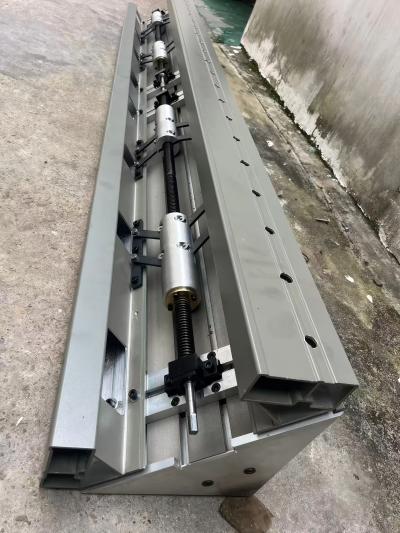 our formwork combines exceptional structural rigidity with lightweight properties (30-40% lighter than traditional steel formwork). This not only simplifies on-site handling and installation but also ensures superior durability, resisting deformation even under high concrete pouring pressures—critical for maintaining the strict verticality and flatness requirements of elevator shafts.
The core advantage of our self-climbing system lies in its integrated hydraulic lifting mechanism, which enables automatic climbing without the need for cranes or external hoisting equipment. This cuts down construction cycle time by 20-30% per floor, while the precision-engineered aluminum panels (dimensional tolerance ±1mm) guarantee consistent shaft inner diameter and wall smoothness—eliminating post-pouring trimming work and laying a solid foundation for subsequent elevator installation.
Construction Process of Self-Climbing Aluminum Formwork for Elevator Shafts
Step 1: Preparatory Work & Initial Installation
Step 2: Concrete Pouring & Curing
Step 3: Stripping & Self-Climbing
Step 4: Positioning & Cycle Repetition
After climbing to the target floor, the formwork is repositioned and fixed using clamping and positioning devices. The process of concrete pouring, curing, stripping, and climbing is repeated until the construction of all elevator shaft floors is completed.


 Evan Xiao